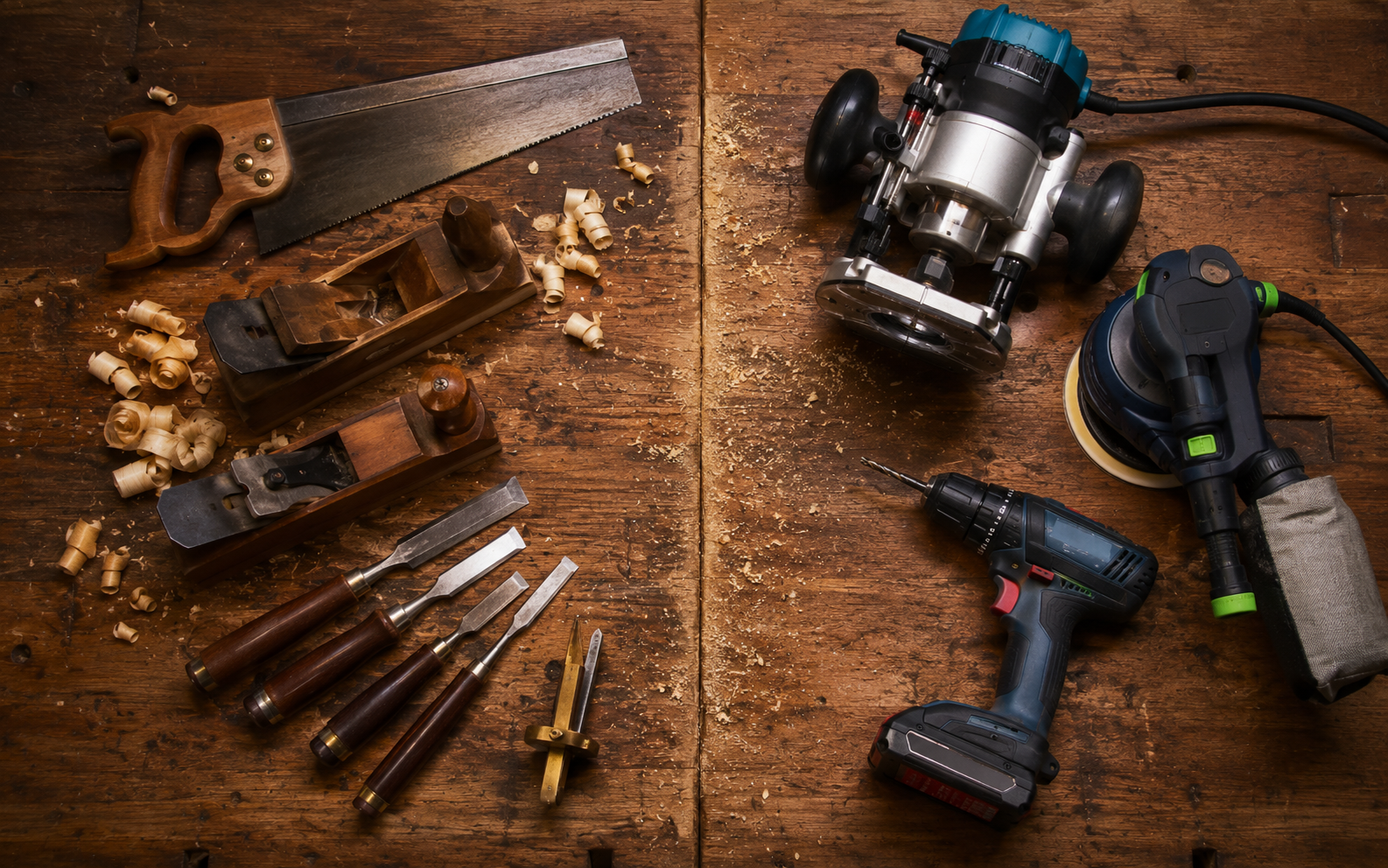
Walk into any woodworking forum and you'll find the same argument playing out on repeat: hand tools versus power tools. Purists on one side insist that real craftsmanship requires nothing more than a sharp plane and a steady hand. On the other, pragmatists argue that routers and table saws exist for a reason — to get the job done faster and more accurately.
The truth, as with most things in the workshop, lies somewhere in between. Both approaches have their place, and the best woodworkers tend to be the ones who know when to reach for which.
The Case for Hand Tools
Hand tools offer something that no power tool can replicate: direct, tactile feedback. When you push a hand plane across a board, you feel the grain. You hear the whisper of the shaving curling away. You develop an intuitive understanding of the wood that simply doesn't happen when you're feeding stock through a thickness planer at speed.
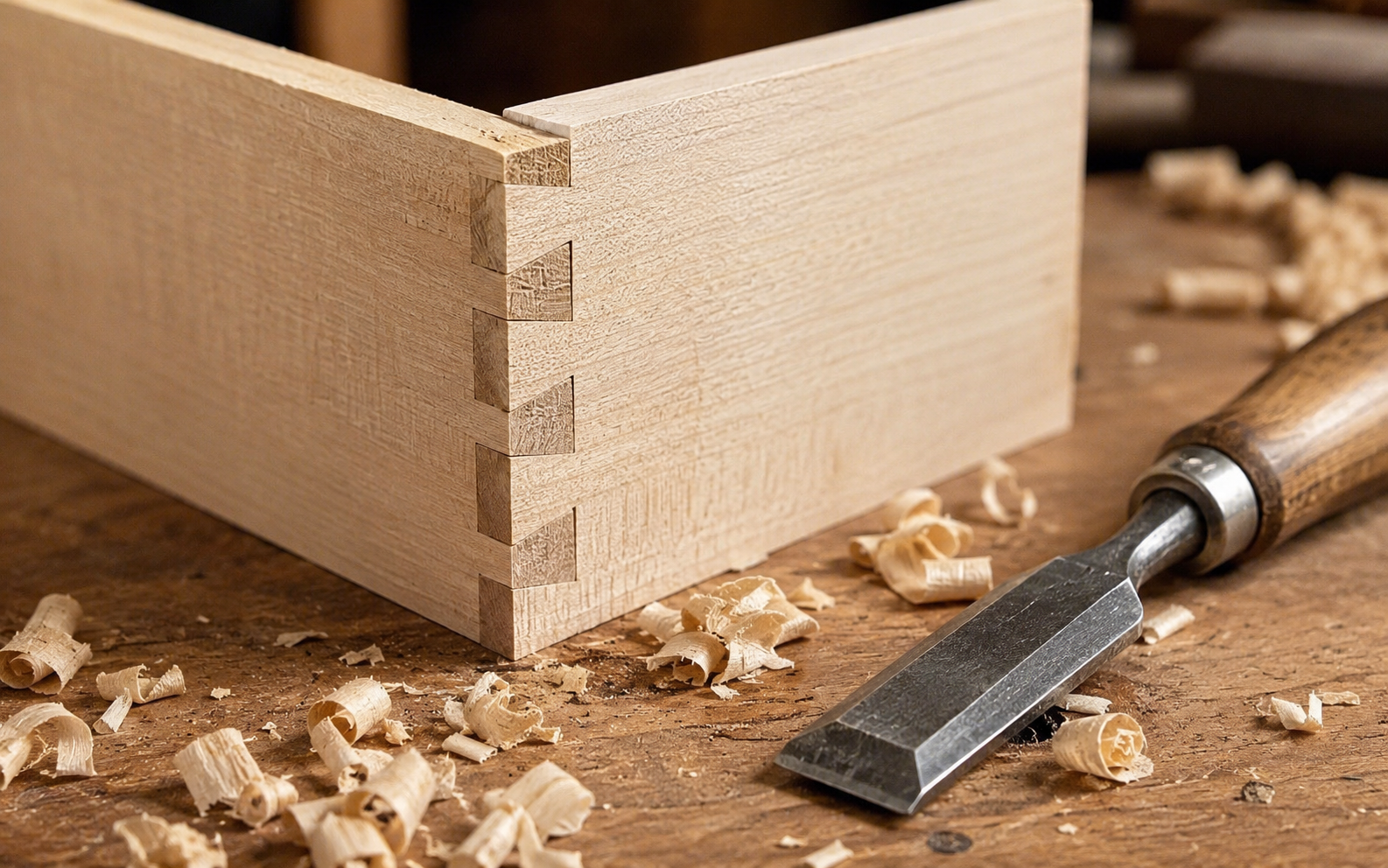
There's also the matter of control. A chisel in skilled hands can make adjustments measured in thousandths of an inch. Try that with a router and you'll quickly appreciate the difference. Hand tools excel at fine work — fitting joints, paring tenons, shaping curves that need to feel just right under the hand.
And then there's noise. Or rather, the lack of it. A workshop running on hand tools is a quiet place. You can think. You can listen to music or a podcast without ear protection. For many makers, this alone is reason enough to keep the power tools unplugged.
The Case for Power Tools
But let's be honest: if you need to break down a stack of rough lumber into dimensioned stock, doing it entirely by hand is an exercise in endurance, not craftsmanship. Power tools handle the grunt work — the milling, the repetitive cuts, the heavy material removal — so you can spend your energy where it actually matters.
A table saw rips a straight line in seconds. A planer surfaces a board in a single pass. A drill press bores perfectly perpendicular holes every time. These aren't shortcuts. They're efficiencies that free you up to focus on the creative and skilled parts of your work.
For anyone building furniture or taking on larger projects, power tools aren't optional — they're foundational. The question isn't whether to use them, but how to use them well and safely.
Finding Your Own Balance
The most satisfying approach is usually a hybrid one. Use power tools to do the heavy lifting — dimensioning lumber, cutting joints to rough size, hogging out waste. Then switch to hand tools for the refinement — fitting, smoothing, shaping, and finishing.
This isn't a compromise. It's a workflow that plays to the strengths of each type of tool. You get the speed and consistency of machines where precision is mechanical, and the sensitivity and control of hand tools where precision is artistic.
Start by assessing what you're building and what matters most in the finished piece. A workbench can be built almost entirely with power tools. A jewelry box might demand more hand work. Neither approach is wrong — they're just different paths to the same destination.
The Tools Don't Define the Maker
Ultimately, the tools are just tools. What defines the maker is the intention, the care, and the knowledge behind the work. A beautifully dovetailed drawer is impressive whether it was cut by hand or with a jig and router. What matters is that it fits, that it functions, and that it was made with attention.
Don't let anyone tell you there's only one right way to work wood. Build your toolkit around your projects, your space, your budget, and your temperament. The best tool is the one that helps you make something you're proud of.