A piece of furniture is only as strong as its joints. You can choose the finest timber, apply a flawless finish, and design with impeccable proportions — but if the joints fail, everything falls apart. Literally. Joinery is the invisible architecture of woodworking, and understanding the basics is essential for anyone who wants their work to last.
The good news is that you don't need to master every joint in existence. A handful of fundamental connections will carry you through most projects, and mastering even two or three puts you ahead of the curve.
The Butt Joint and Why It's Not Enough
The butt joint is the simplest connection in woodworking: two pieces of wood meeting end to end or end to face, held together with glue, screws, or nails. It's quick, it's easy, and it's weak. The end grain of wood absorbs glue poorly, creating a bond that's unreliable under stress.
That doesn't mean butt joints are useless. For quick jigs, rough construction, and non-structural assemblies, they're perfectly fine. But for furniture — anything that will bear weight, resist racking, or need to survive years of use — you need something better.
The butt joint is your starting point, not your destination. Every other joint in woodworking exists to solve the problems that the butt joint can't.
Mortise and Tenon: The Workhorse
If you learn only one joint beyond the butt, make it the mortise and tenon. It's been used for thousands of years — as the history of woodworking makes clear, ancient Egyptian furniture was built with mortise and tenon joinery — and there's a reason it endures. It's strong, it's versatile, and it can be cut with both hand and power tools.
The concept is straightforward: a projecting tenon on one piece fits into a corresponding mortise (hole) in the other. The mechanical interlock provides strength, and the long-grain-to-long-grain glue surface ensures a durable bond. Properly executed, a mortise and tenon joint will outlast the wood around it.
Variations abound. Through tenons pass entirely through the receiving piece and can be wedged for additional strength. Blind tenons stop short, hiding the joint completely. Haunched tenons add extra resistance to twisting. Once you understand the basic principle, you can adapt it to almost any situation.
Dovetails: Form and Function
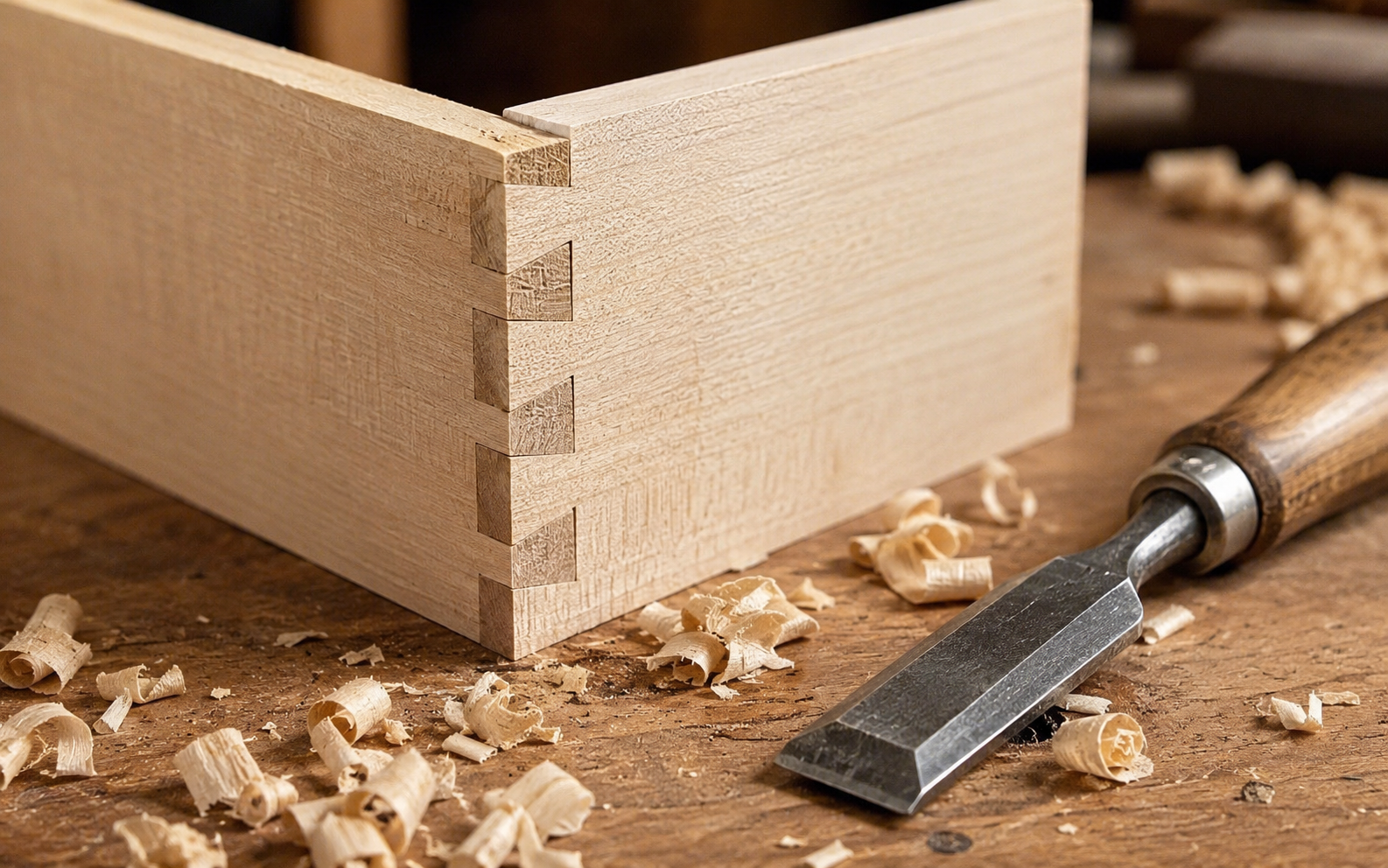
Dovetails are the joint that most people recognize, even if they can't name it. The interlocking pins and tails create a mechanical bond that resists being pulled apart in one direction — which is exactly what happens when you open a drawer. That's why dovetails have been the standard drawer joint for centuries.
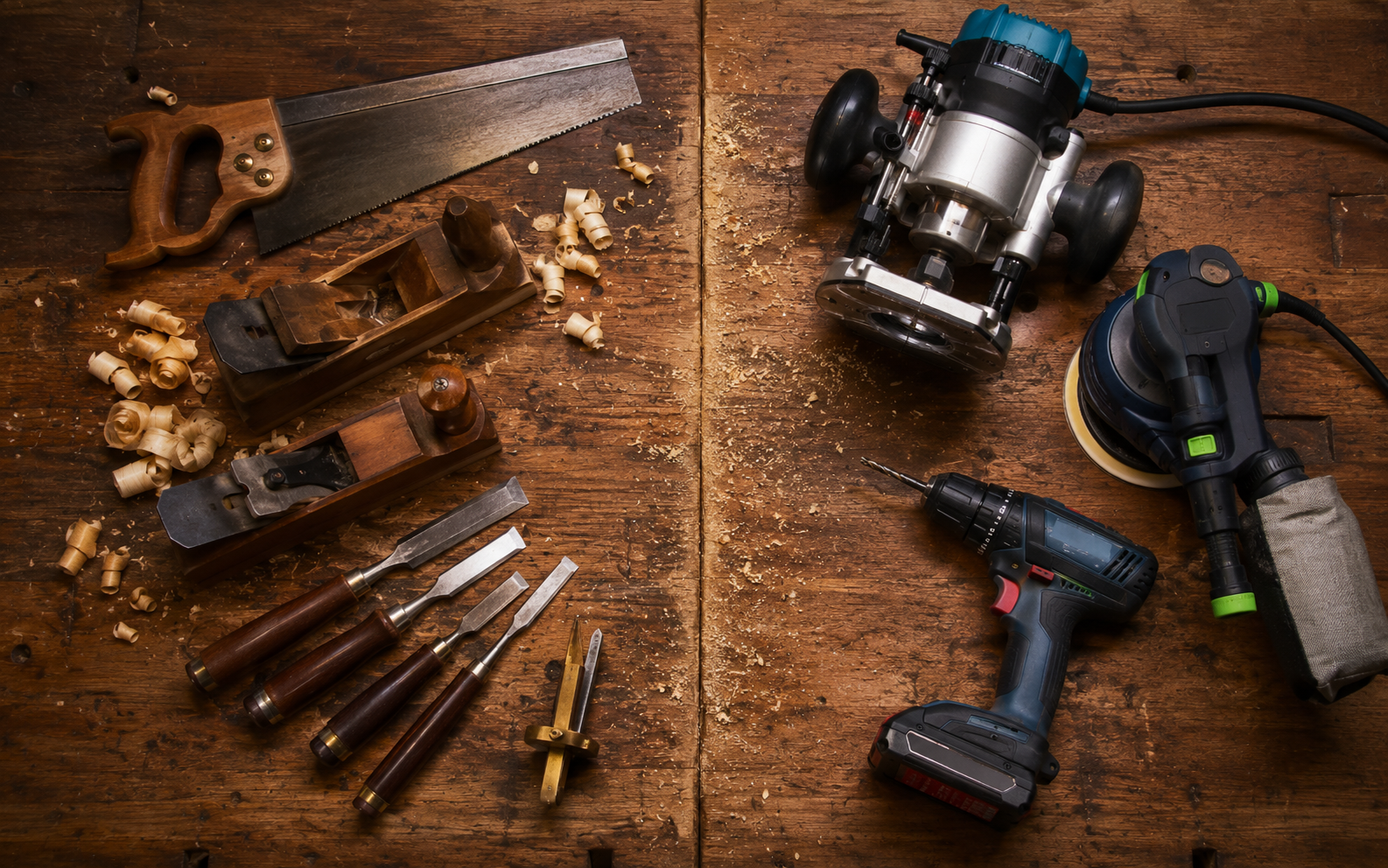
Cutting dovetails by hand is a skill that takes practice, but it's deeply satisfying to develop. The process teaches precision, patience, and the proper use of saws and chisels. Many woodworkers consider their first tight-fitting dovetail a milestone — the moment when the craft starts to feel like it belongs to them.
Machine-cut dovetails, made with a router and jig, are faster and more uniform. They lack some of the character of hand-cut joints — the slight irregularities that mark them as human-made — but they're perfectly functional and far stronger than any alternative for drawer construction.
Getting Started with Joinery
The best way to learn joinery is to practice it in isolation before committing to a project. Cut a dozen mortise and tenon joints in scrap wood. Make a pile of dovetailed corners. Test them. Break them. Learn how tight is tight enough and how sloppy is too sloppy.
Start with softwood — pine is cheap and forgiving. Move to hardwood once your technique is consistent. Pay attention to your marking tools: a sharp marking knife, a reliable square, and a good marking gauge are more important than any saw or chisel when it comes to accurate joinery.
And remember: a gap-free joint isn't the only measure of success. A joint that's slightly imperfect but structurally sound is far better than one that looks pretty but doesn't hold. Function first, beauty second. With practice, you'll get both.